Chocolate Lava Cake Recipe: The Restaurant Technique That Changes Everything
This is a restaurant dessert.
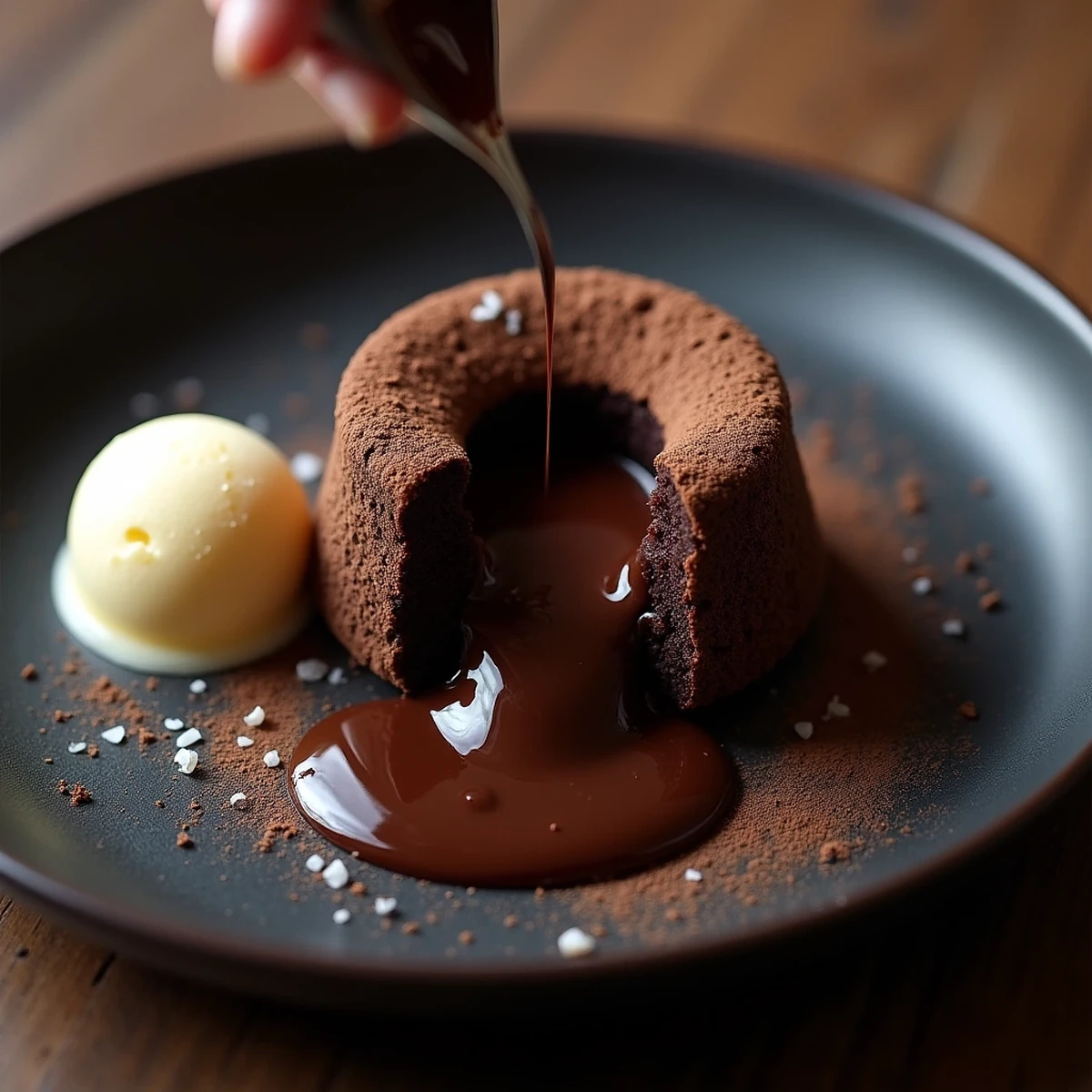
This is a restaurant dessert. And you’re making it at home tonight.
The chocolate lava cake — fondant au chocolat in French, though the name doesn’t fully capture what happens when you cut into it — is the kind of dessert that makes a table go quiet. That moment: the fork pressing through the barely-set shell, the warm center flowing out like something from a dream. I charged $16 for this at the restaurant. You’re going to make four of them tonight for about $9, and they will be, without question, remarkable.
The technique that makes this extraordinary is understanding the difference between a cake that is underbaked and a cake that is intentionally, precisely underbaked. There is a window — and I mean a window of perhaps two minutes — where the outside has set into a tender, yielding crumb and the inside remains liquid, trembling, ready. Miss it on one side and you have a puddle. Miss it on the other and you have a very small chocolate cake. Hit it exactly right and you have one of the great desserts of the classical French kitchen. I’ll give you every signal you need to find that window.
Sophie’s pairing for this, always: a small glass of Banyuls — the fortified Roussillon wine that matches dark chocolate like nothing else on earth. A good espresso works equally well. What you do not need is a reservation, a white tablecloth, or a reason beyond the fact that it is evening and you deserve something extraordinary. That is reason enough.
Ingredients
- 170g (6 oz) dark chocolate, 70% cacao, roughly chopped — use the best quality available to you; this is the entire flavor of the dessert
- 115g (8 tablespoons) unsalted butter, French-style 82%+ fat, cut into cubes, plus extra softened butter for greasing the ramekins
- 2 large eggs, at room temperature
- 2 large egg yolks, at room temperature
- 75g (1/3 cup) caster sugar
- 1 teaspoon pure vanilla extract
- 1/4 teaspoon fine sea salt
- 25g (3 tablespoons) all-purpose flour, sifted
- 1 tablespoon Dutch-process cocoa powder, for dusting the ramekins
- Flaky sea salt, for finishing — Maldon or fleur de sel
- Vanilla ice cream or crème fraîche, for serving
Instructions
-
- Prepare your ramekins first, before anything else. Brush four 170ml (6 oz) ramekins generously with softened butter — coat every surface, including the rim. Dust with cocoa powder, tilting and tapping to coat evenly, then invert and tap out any excess. This step is what allows the cakes to release cleanly. Set the prepared ramekins on a baking sheet and refrigerate until needed.
-
- Preheat your oven to 220°C (425°F). A properly hot oven is essential — the intense heat sets the exterior quickly while leaving the center liquid. Do not rush the preheat.
-
- Melt the chocolate and butter together. Place the chopped chocolate and cubed butter in a heatproof bowl set over a saucepan of barely simmering water — the bottom of the bowl should not touch the water. Stir gently and continuously until the mixture is completely smooth and glossy. Remove from the heat and set aside to cool for 5 minutes. The mixture should feel warm but not hot when you touch the side of the bowl.
-
- Now — and this is the technique that changes everything — whisk the eggs, egg yolks, and sugar together until the mixture is pale, thick, and has doubled in volume. This takes 3 to 4 minutes with a hand mixer at medium-high speed, or 5 to 6 minutes by hand with a balloon whisk. You are incorporating air into the structure, which is what gives the outer shell its tender, just-set texture. Do not skip this step. Do not rush it.
-
- Add the vanilla extract and fine sea salt to the egg mixture and whisk briefly to combine.
-
- Pour the warm chocolate-butter mixture into the egg mixture and fold gently with a rubber spatula — long, sweeping strokes from the bottom of the bowl upward. You want to preserve the air you built in the previous step. Fold until no streaks of egg remain.
-
- Sift the flour over the chocolate mixture and fold it in with the same gentle motion. Stop the moment the flour disappears. Overmixing at this stage develops gluten and toughens the exterior. Twelve to fifteen folds, maximum.
-
- Divide the batter evenly among the four prepared ramekins, filling each about three-quarters full. At this point, the batter can be covered and refrigerated for up to 24 hours — bring back to room temperature for 30 minutes before baking.
-
- Bake for 10 to 12 minutes. Watch closely from the 10-minute mark. The edges of the cakes should be set and pulling very slightly away from the sides of the ramekin. The center should still have a distinct wobble when you gently shake the pan — it should move like set jello, not ripple like liquid. If the entire surface looks dry and firm, you have gone a minute too far. This is the moment. Trust it.
-
- Remove from the oven and let the ramekins rest on the baking sheet for exactly 1 minute — this allows the cakes to compose themselves before unmolding. Run a thin knife around the interior edge of each ramekin. Place a warm plate face-down over the ramekin, then invert swiftly and decisively. Hold for three seconds, then lift the ramekin. The cake should release cleanly onto the plate.
-
- Finish each cake with a pinch of flaky sea salt — this is not optional; it is the contrast that makes the chocolate sing. Serve immediately, with a quenelle of vanilla ice cream or a generous spoonful of crème fraîche alongside. The lava will not wait.
Nutrition
Tips
1. The 70% cacao rule is real. The chocolate is not a background ingredient — it is the entire dessert. A chocolate below 60% cacao will produce a cake that is sweet but shallow. A chocolate above 75% cacao can become bitter and seize during melting. The 68 to 72% range gives you depth, richness, and the bittersweet contrast that makes this dessert remarkable. Valrhona Guanaja, Callebaut 70-30-38, or a quality grocery store 70% bar will all serve you well.
2. Make the batter the night before. This recipe is entirely achievable as a dinner party dessert precisely because the batter can be portioned into ramekins and refrigerated up to 24 hours ahead. Remove from the refrigerator 30 minutes before your guests sit down for the main course. By the time dinner finishes, the batter is at room temperature and you need only ten minutes of oven time. Your guests will believe you are extraordinary. You are — but this technique helps.
3. The test bake. If you are making this for the first time, or for a special occasion where failure is not a preferred outcome, bake one ramekin as a test the day before. Every oven runs differently — some run hot, some run cool — and ten minutes in your oven may mean something different than ten minutes in mine. The test bake costs you one cake and gives you complete confidence for the rest. Worth every minute.